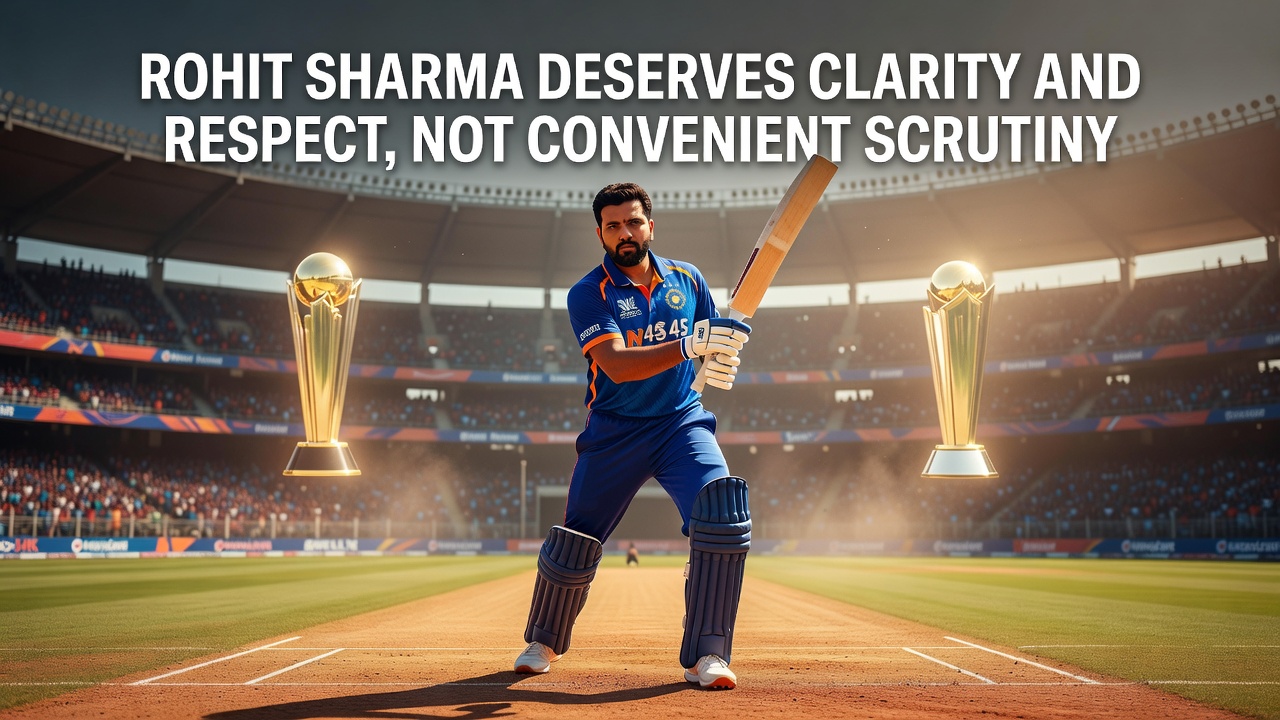
Rohit Sharma Deserves Clarity and Respect, Not Convenient Scrutiny
There is a peculiar ritual that plays out with numbing regularity in Indian sport: build a hero with great enthusiasm, then dismantle him with equal fervour. Rohit Sharma, one of the most decorated limited-overs cricketers this country has produced, is now at the centre of that cycle. The question worth asking is not merely whether he will feature at the 2027 ODI World Cup in Africa, but whether the manner in which that debate is being conducted is remotely fair to a man who has delivered two ICC trophies in the space of nine months.
The framing of Rohit's situation in the months since IPL 2026 has been selective at best. He arrived at the tournament visibly trimmer, opened the season with a blistering 78, and after a hamstring injury interrupted his campaign, returned to strike 84 at the Wankhede before adding further contributions to finish as Mumbai Indians' fourth highest run-getter despite missing five matches - 283 runs at a strike-rate of 157.22. Those are not the numbers of a man in terminal decline. Yet the injury, not the recovery or the output, became the dominant storyline. It is worth noting, as an aside, that the frenetic world of competitive gaming operates on a similarly unforgiving scrutiny cycle - followers of ewc sea dota 2 will recognise how quickly narratives around elite performers shift from celebration to interrogation the moment vulnerability is perceived. The mechanism is the same across disciplines: the pedestal and the pitfall are never far apart.
Virat Kohli, navigating the same crossroads as Rohit, said as much in a recent podcast. "I work as hard, if not harder than anyone else," he stated. "After operating like this, if I have to be in a place where I have to prove my worth and value, that place is not meant to be for me." Kohli's IPL 2026 - a career-best strike-rate of 165.84 and a fourth-place finish in the run-scoring charts - bought him what the discourse generously labels "breathing room." Rohit's IPL, objectively comparable in context and output, somehow bought him the opposite. The inconsistency is glaring.
A Legacy That Earns More Than Potshots
It is worth remembering what Rohit has actually done. He captained India to the 2024 T20 World Cup title in the West Indies, ending an 11-year ICC trophy drought, contributing incisive innings along the way including against Australia in the group stage and England in the semifinal. Nine months later, he led India through an unbeaten Champions Trophy campaign in Dubai, their first 50-over title since 2013. Two formats, two trophies, in less than a calendar year. His record as a limited-overs captain places him alongside Mahendra Singh Dhoni as the most successful in India's history. Context matters, and that context demands a baseline of respect.
His Test record in that intervening period tells a harder story - one half-century across 15 innings against Bangladesh, New Zealand and Australia, followed by a self-imposed omission from the Sydney Test and, eventually, retirement from the five-day format. That chapter is closed. What remains is a single canvas: ODI cricket, and the question of whether he can contribute meaningfully to a World Cup campaign that begins in roughly 13 months. At 39, he will be 40 and a half when that tournament starts. These are facts, not indictments.
Ambivalence From the Top Only Deepens the Wound
What makes Rohit's position particularly uncomfortable is not public opinion - that has always been volatile - but the apparent ambivalence within Indian cricket's administrative and selection structures. Vice-captaincy changes in both the Test and T20I formats have been made without convincing public explanation. Shubman Gill's chronic neck problem, which caused him to miss significant matches, has been handled with appropriate empathy and discretion. A similar courtesy has not always been extended to Rohit's hamstring. If the selectors and team management have genuinely moved on from him with respect to the World Cup, the straightforward and humane course of action is to tell him so. What is not acceptable is a drip of pointed remarks and strategic ambiguity that leaves a senior player - and a human being - in a prolonged state of manufactured uncertainty.
The Real Question Is Simple, If Anyone Would Ask It Honestly
Rohit Sharma has never been Virat Kohli in the field. He has never been the boundary-to-boundary sprinter, the relentless between-the-wickets runner, the visible embodiment of athletic intensity at 200 decibels. That was never his game, and it was never required of him to be. What he has always been, since he took guard at the top of the ODI order in January 2013, is one of the most destructive openers in the history of the format - a player capable of reframing a powerplay in three overs, of absorbing pressure and then releasing it with savage precision. The question his critics need to answer honestly is what they are actually asking for: a physically transformed 39-year-old who runs like he is 25, or the batter who wins you tournaments. Because if it is the latter, the evidence of his recent form suggests he is still capable. The smile may have dimmed slightly under the weight of relentless examination. The ability has not.