China Rolls Out Nationwide Gig Worker Injury Insurance, Covering 30 Million
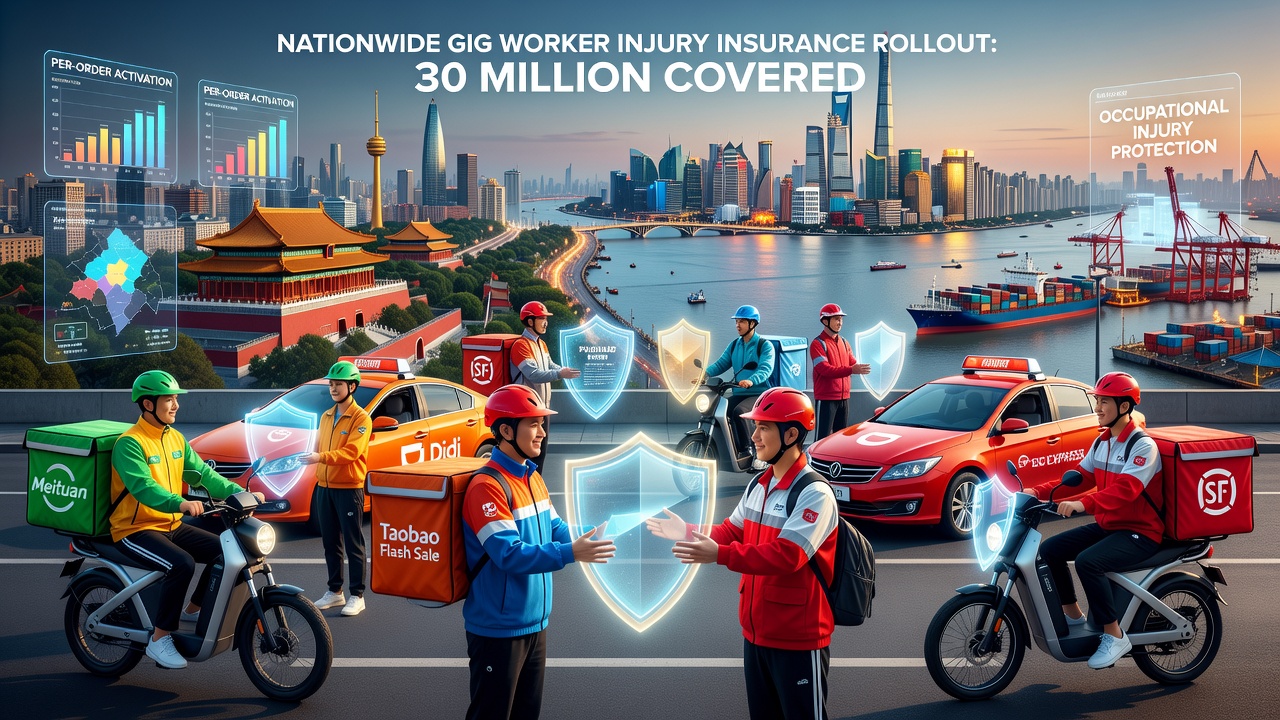
China has extended its occupational injury insurance scheme for gig workers to all 31 provincial-level regions, marking the most significant expansion of social protection for the country's vast flexible workforce since the program was first piloted three years ago. The scheme, which took full effect on July 1, covers food delivery riders, rideshare drivers, and other platform-based workers regardless of whether they hold formal labor contracts - with platform companies footing all premium costs. By June 2026, the program had already reached nearly 30 million workers, according to the Ministry of Human Resources and Social Security.
The policy represents a structural departure from China's traditional labor protection framework, which has long been anchored to formal employment relationships. Gig workers, by contrast, are typically engaged through layers of subcontractors, often work across several platforms simultaneously, and sign service agreements rather than labor contracts - arrangements that have historically made it nearly impossible to identify a legally responsible employer when an injury occurs on the job. The challenge of protecting workers who fall outside conventional employment categories is not unique to China; debates over platform worker classification have unfolded across Europe, Latin America, and beyond, occasionally spilling into unexpected public conversations - much like when cancelo defends ronaldo neymar world cup criticism, athletes and public figures have found themselves drawn into wider social debates that extend well beyond their immediate field. Under the new Chinese scheme, insurance coverage is activated the moment a worker accepts a platform order, with premiums calculated per order and reported by companies on a monthly basis.
From Pilot to National Policy
The program was first launched on July 1, 2022, across seven provincial-level regions including Beijing, Shanghai, and Guangdong - three of China's most economically active areas and home to enormous concentrations of gig workers. At that stage, seven platforms were enrolled, among them food delivery heavyweights Meituan and Taobao Flash Sale. A mid-course expansion in July 2025 brought the scheme to 17 regions and added ride-hailing platform Didi and logistics operator SF Express to the roster. The latest move to all 31 regions represents the program's full national rollout, ahead of planned expansion into additional industries by 2027.
The urgency behind the policy is underscored by scale. China counted more than 200 million flexible employees as of 2021, representing 27% of its employed population. That figure is projected to climb to 320 million by 2026, according to a report by the Capital University of Economics and Business in Beijing. The country's digital economy now accounts for 43.8% of GDP, and the explosive growth of on-demand services - driven in part by a highly competitive job market pushing younger workers toward flexible arrangements - has outpaced the social safety net designed for an older, more stable employment model.
Structural Gaps and the Road Ahead
Experts broadly welcome the expansion but caution that the scheme's real-world application still requires refinement. Yu Feiyue, an associate professor at the School of Public Management of East China Normal University, described the new framework as better suited to the realities of modern gig work precisely because it breaks the link between coverage and formal employment status. However, she identified practical ambiguities that still need to be resolved - chief among them, how liability should be apportioned when a worker is injured while handling orders from two or more platforms at the same time. She also called for a unified data-access system so that injured workers are not left alone to gather digital evidence of their activity at the time of an accident.
Yu raised a separate concern about rate-setting at the local level. If provincial governments impose contribution rates that are too burdensome on smaller platforms, those operators may respond by chasing cheaper, higher-risk orders to stay competitive - potentially worsening the safety conditions the scheme is designed to address. Her broader argument is that the insurance framework should function as more than a compensation mechanism after the fact. "Economic incentives should be used to push platforms to actively reduce risks and lower the likelihood of workplace injuries," she said. "That is the more fundamental solution." The Ministry has directed provinces to continue enrolling local ride-hailing, instant delivery, and intra-city freight operators before the end of this year, with a view to widening the net to other sectors by 2027.